
Interview for Cyprus Butterfly
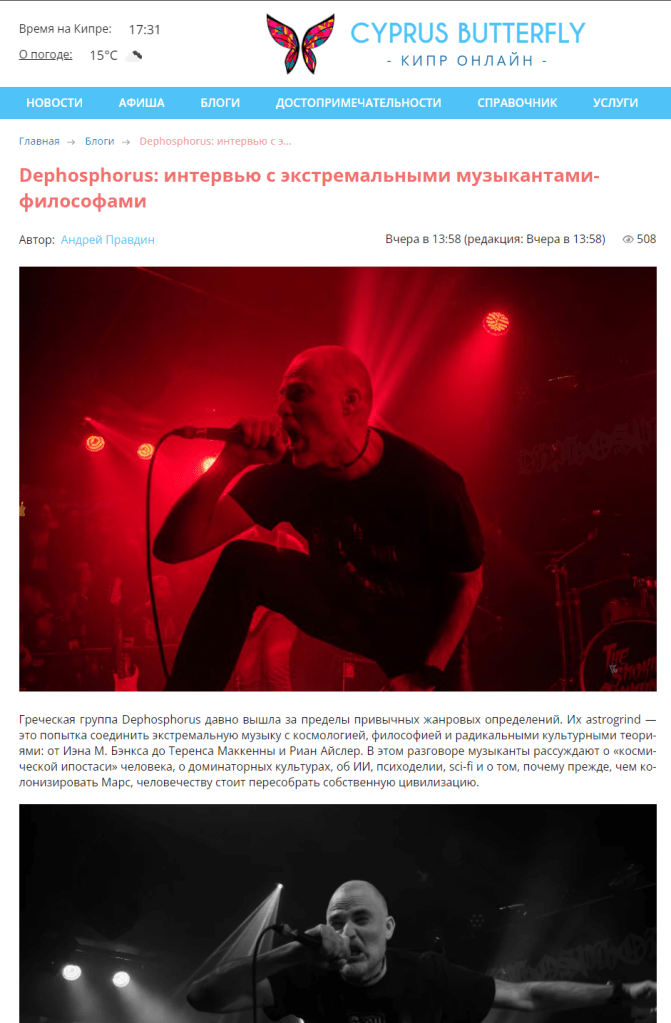
In anticipation of our forthcoming gig in Nicosia next Thursday, April 9th, here’s a deep conversation we’ve had with Cyprus Butterfly, a website for Russian expats living in Cyprus: https://cyprusbutterfly.com.cy/blogs/dephosphorus-intervyu-s-ekstremalnyimi-muzyikantami-filosofami
If you don’t read Russian, here’s the English version.
– Let’s start with the meaning of the band’s name. As I understand it, Dephosphorus suggests a kind of “moving away from light.” Is that interpretation correct?
Well, not exactly. It comes from the name Phosphoros, which means “bringer of light” and is the morning star (aka the planet Venus) in Greek. As you may also know Phosphorus is a chemical element represented by the symbol P and having the atomic number 15.
Since that name was already taken, we found a way to adapt it for ourselves by adding the prefix De- at the beginning. In one sense, that also reflects the influence of Mayhem’s De Mysteriis Dom Sathanas album and, more broadly, the aesthetic lineage of certain death-metal bands with similar naming structures.
– You describe your style as astrogrind, but in reality it combines grindcore, black metal, crust and death metal. Can we say that you are exploring new sonic territories within extreme music? I’ve even heard that Marco detects some rebetiko influences — is that true? Have you ever considered incorporating electronic elements into your music, similar to what The Berzerker did in the past?
Who said that the combination of all these extreme genres, together with a cosmic/astral concept, is not astrogrind? We chose to call our music that way – it’s entirely up to us to shape it, and then up to the listeners to interpret and accept it, or not.
There are definitely rebetiko influences in there as well. Thanos has been a fan of this music for more than twenty years, so it makes sense that it would find its way into the sound in one form or another.
As for electronics, we have already incorporated them many times in our recordings, including live electronics and other elements contributed by collaborators such as Panos Alexiadis and Miltos Schimatariotis, who have been pioneers in shaping the electronic dimension of Dephosphorus’ sound.
– Your compositions sound chaotic yet highly structured. How intentional is this balance?
It’s simply our way of composing music. There isn’t a calculated intention behind how this balance appears, nor a formula we try to follow. Most of it comes down to feeling and to sound itself – and more often than not, the latter becomes the main force shaping what a track eventually becomes.
To us, “balance” is a delicate concept. But then again, even in space there is some form of balance, right?
– What matters more to you: sonic intensity or conceptual coherence?
Both are equally important for us, however we couldn’t have the latter without the former. We are a band playing extreme, heavy music, and our concept is built on top of an aggressive music foundation.
– Your influences include bands like Nasum, Knut, Anodyne, Leviathan, and Voivod – all musically complex acts. Do you think modern lifestyle trends are making audiences more primitive in their tastes? Would you agree that in the 1990s there was a stronger demand for psychedelic and avant-garde music?
Even today the demand for psychedelic and avant-garde music is still there. Every era has its own challenges, but what has really changed over the years is accessibility – now many more people can discover both new and old bands, compare them, and learn through that process in ways that simply weren’t possible before.
There are so many genres that modern lifestyle has introduced and stabilized that it would be unfair to say audiences have developed more primitive tastes. In our view, the thirst for the kind of music we play and support will always exist – precisely because it can never be perfect.
– You consistently experiment with sound. Do you plan to continue pushing these boundaries? What is the ultimate goal of this experimentation – to discover something previously unheard? Are you concerned that the music could become too complex and alienate part of your audience?
Experimentation naturally emerges over time as our ears begin to recognize certain patterns or formulas and eventually refuse to keep following them. Then another approach takes over – reshaping sound, compressing or suppressing tempo, or drawing textures where previously there was nothing.
We are human and curious; the need to evolve is completely natural. So experimenting with sound and its form happens whenever our ears and minds lead us there. There isn’t necessarily an “ultimate goal” of discovering something unheard – it’s more a continuous process of transformation.
We’re never concerned about becoming too complex or alienating part of the audience. Our roots are deeply embedded in the punk/crust/grind tradition and that will always remain the core, because that’s how we genuinely enjoy playing our music. Differences may appear, textures may be added, and atmospheres may change – but the overall aura of Dephosphorus is very clear and certain.
– Your work frequently references astrophysics and cosmic themes. Where does this fascination with space and science originate?
– Some might argue that cosmic themes allow artists to escape immediate social realities. Do you think your focus on space ever distances you from real-world social concerns?
Let’s bundle the answers to those two questions together.
Our fascination with space originates, first of all, from the primeval, instinctive inclination to raise our heads and observe the heavens: the sun, the moon, the stars, the Milky Way. After all, the Greek word for human, Anthropos, translates to “the one who looks above.”
Some of us were also raised devouring sci-fi literature, alongside a deep intrigue for the cosmic mechanics theorized by astronomy and cosmology. When we formed Dephosphorus, the cosmic theme wasn’t a calculated choice; it was a moment of synchronicity where our personal lives and artistic quests simply clicked into place.
There’s a classic Calvin and Hobbes strip by Bill Watterson that captures our intent perfectly:
CALVIN: If people sat outside and looked at the stars each night, I’ll bet they’d live a lot differently.
HOBBES: How so?
CALVIN: Well, when you look into infinity, you realize that there are more important things than what people do all day.
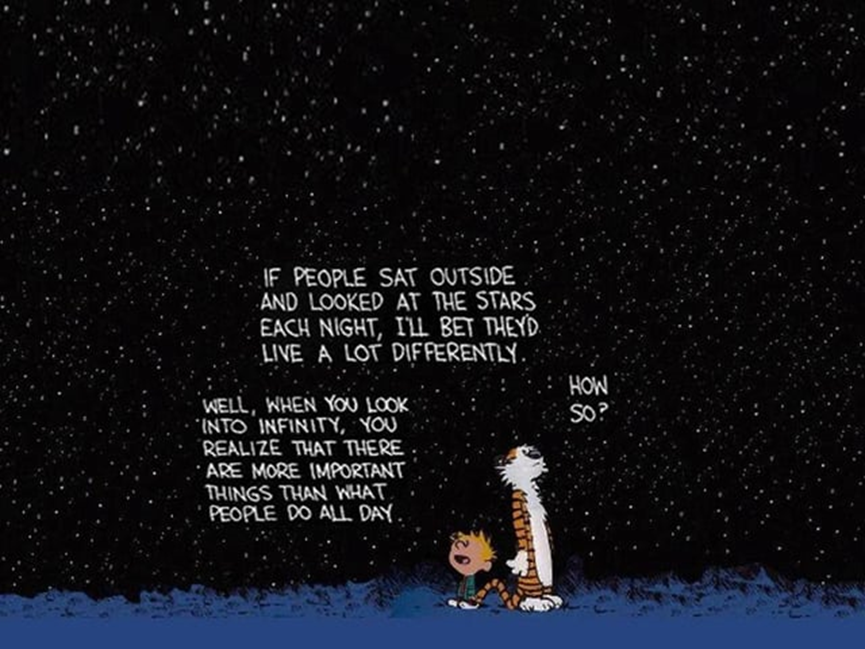
That quote accurately mirrors our intentions from the start. However, as we’ve progressed, we’ve begun to look deeper into the “why” behind this perspective.
More recently, we’ve been inspired by Riane Eisler’s archetypes of the Chalice and the Blade, which have given a new vocabulary to our existing cosmic outlook. It provides a historical framework for the “retuning” of civilization that we feel is necessary. We see the original harmony of “Old Europe” and the egalitarian civilizations of Mesopotamia and Asia—the “Chalice”—being eclipsed by the “Blade” of Indo-European and early Hebrew dominator cultures. This shift turned technology away from life-enhancement and toward the violence of the atomic bomb and the gun.
While these specific theories are a relatively new addition to our conceptual toolkit, they feel like the missing pieces of the puzzle. They help us articulate a clearer path forward: using our music and our current cosmic understanding to help push past this inherited cycle of destruction, so we can finally harmonize with the scale of the universe we are part of.
– You often emphasize the aesthetic of cosmic eternity. How would you describe your attitude toward the Universe, Earth, space travel, the colonization of Mars, or the possibility of extraterrestrial civilizations? In your opinion, is human society ready for the colonization of other planets?
As explained above, our fascination with the cosmos and us being an integral part of it leads us to reflecting on what separates us from it. We came recently to the conclusion that it is dominator cultures—the severing of our link from other lifeforms, the Earth/Universe, and ultimately ourselves.
Therefore, before considering space travel and colonizing the solar system, then the galaxy and beyond, we should start from a clean slate by transforming human culture.
So no, we are not ready for it.
If you think of it in a modern actuality sense, think of Elon Musk:
- He is devoting immense resources in preparation for the colonization of Mars while we are experiencing a full-blown ecological catastrophe.
- Furthermore, he has negotiated an—albeit temporary—alliance with somebody who fights science and, in particular, denies climate change.
– I understand that your album Sublimation was influenced by the author Iain Banks. I’ve read The Wasp Factory and found it deeply impactful. Which other ideas or works by Banks have influenced your artistic vision?
First off, it’s refreshing to speak with someone who has actually read Banks; we appreciate the deep dive. We just spoke about the transformation of human culture, which leads perfectly into why we are so inspired by him. Specifically, we are fascinated by his Culture concept: an egalitarian future society where humans, aliens, and AI cooperate for peace and prosperity across the galaxy.
By mentioning Iain Banks without his middle initial “M.” and citing The Wasp Factory, you’re actually referring to his mainstream fiction. While those are powerful works, we are more heavily influenced by his sci-fi body of work produced as “Iain M. Banks,” which includes (but isn’t limited to) the Culture novels.
Beyond the grand scale of that setting, we’ve been deeply moved by his:
- Humanity & Sophistication: His ability to anchor vast ideas in genuine emotion.
- Dark Humor: A sharp, intellectual wit that balances his wild imagination.
- Relatable Personas (Even the Alien): Banks had a rare gift for making characters relatable even when they are biologically or linguistically “other.” A perfect example is Feersum Endjinn, where he writes through a protagonist using a phonetic, quasi-gibberish dialect. Despite the initial barrier of the language, the character’s soul feels completely familiar and human.
- Character Development: His skill in building elaborate, nuanced identities within vast, operatic settings.
Banks has influenced our lyrics and aesthetics from the very beginning. We even dedicated our second full-length album, Ravenous Solemnity, to him after he left this world in 2013. He is sorely missed and remains an integral part of Dephosphorus’ journey.
– If you were to embark on a space journey, which five albums would you take with you?
Thanos
- Dephosphorus – Planetoktonos
- Death – Human
- Oranssi Pazuzu – Värähtelijä
- Manos Hadjidakis – Gioconda’s Smile
- Autechre – Tri Repetae
John
- Iron Maiden – Seventh Son of a Seventh Son
- Rush – 2112
- Rainbow – Rising
- King Crimson – In the Court of the Crimson King
- Klaus Schulze – Deus Arrakis
Costas
- Burzum – Filosofem
- Annihilator – Bag of Tricks
- Eloy – Time to Turn
- Iron Maiden – Iron Maiden
- Kindzadza – Waves of Inner Space
Panos
- Biosphere – Microgravity
- Vangelis – Blade Runner (Original Score)
- Electric Wizard – Come My Fanatics…
- Timeghoul – 1992-1994 Discography
- Voivod – Angelrat
– Greece has produced a powerful extreme metal scene. How do you position Dephosphorus within that context? Do you feel more connected to the Greek underground or to the international extreme metal network?
As mentioned before, Dephosphorus is not a typical band with constant touring and countless live shows. Because of work and family responsibilities, we operate in a very focused way and within limited time frames. Over the years this inevitably made us lose touch with some people, but we still meet familiar faces who continue playing in bands, and that always feels great.
The extreme metal scene in Greece is substantial, especially in Athens but also in smaller cities. Since we rarely play abroad, our physical presence is mainly within the Greek underground. We play a demanding genre that will probably always remain underground – the mainstream will never elevate Dephosphorus to those kinds of heights.
At the same time, we’ve built a cult following internationally. It’s moving to see so many people supporting us through Bandcamp and other platforms without ever having seen us live. In that sense, we feel part of the international extreme metal network while still being rooted in the Greek scene. Making people feel excited through our live shows – always focused on quality and chemistry – remains deeply satisfying for us.
– What is your perspective on artificial intelligence? Is it a threat to music and humanity, or a tool and ally?
We see artificial intelligence primarily as a powerful tool for humanity. It allows us to perform tasks in seconds that our ancestors would never have imagined — things that once belonged purely to science fiction.
At the same time, the way AI is programmed is a delicate matter, because it is still shaped by human intention. If we take Asimov’s laws of robotics as an ideal reference, there would be little to fear — yet we must always remember that someone, inevitably, writes the code, and a tool can always backfire.
Ideally, AI should help humanity solve major problems, such as complex and currently incurable diseases like cancer, one of the leading causes of death in our lives. Could it even open the path toward some form of immortality? Who knows — but if that ever happens, then perhaps we could finally begin seriously talking about exploring the Universe.
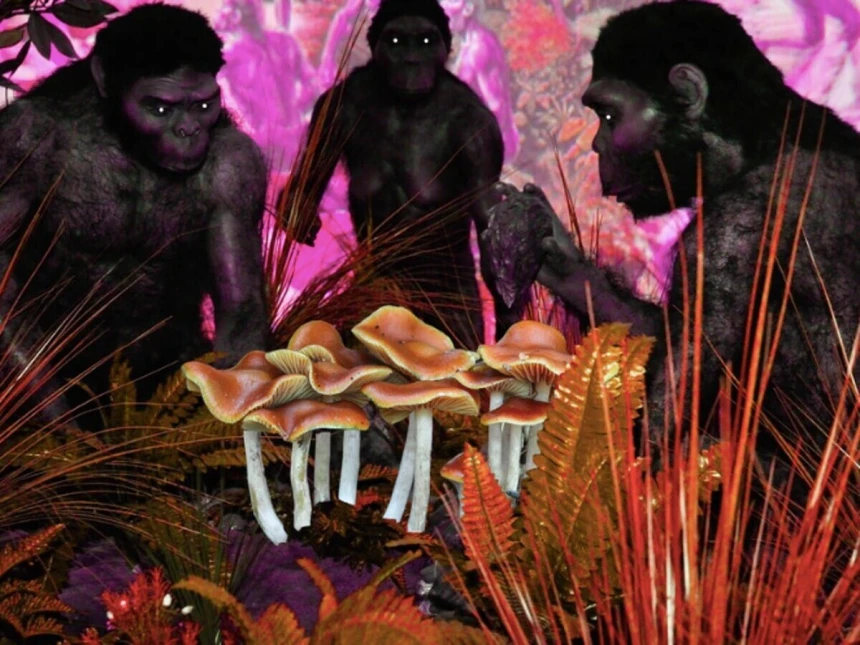
– In a previous interview, you mentioned Terence McKenna. What do you think about his ethnobotanical theories? Have you ever considered creating a conceptual album inspired by his ideas?
Terence McKenna was a pivotal ethnobotanist and visionary whose theories, however ‘far out,’ remain essential food for thought. His most notorious hypothesis—the ‘Stoned Ape’ theory—surmises that the transition from Homo erectus to Homo sapiens was catalyzed by the consumption of Psilocybe cubensis mushrooms. While difficult to verify through the archaeological record, it forces us to ponder a profound biological reality: why do almost all higher organisms possess the complex neural receptors required to interface with psychoactive plants? We find it entirely plausible that this capacity exists to induce novel modes of perception, acting as a direct engine for cognitive evolution.
In a similar vein, the work of Chris Bennett (particularly in Cannabis and the Soma Solution) provides a compelling look at the plant’s role in the ‘Great Leap Forward’ of human evolution. Bennett’s research suggests that cannabis was a primary sacrament in the ancient world, influencing the development of the Vedic, Zoroastrian, and even Judeo-Christian traditions. This points to a co-evolutionary relationship where human consciousness was sculpted by a ‘pharmacopeia of the gods’—a variety of teacher plants providing the metaphysical inspiration for humanity to transcend its primitive origins.
Another concept we deeply identify with is the ‘Archaic Revival.’ McKenna argued that Western society is fundamentally ill because it has severed its ties to the organic, the feminine, and the shamanic. As you likely know as Russians, given Siberia’s deep and ancestral shamanic traditions, these roots are never truly gone—they are simply suppressed. McKenna advocated for a return to the values of the Partnership Period—a timeline that, as Riane Eisler’s work demonstrates, stretched from the Upper Paleolithic through to the sophisticated heights of the Minoan civilization. He viewed ‘ego dissolution’ via the psychedelic experience as the only way to break our rigid ‘cultural operating system’ and reconnect with the Gaia Hypothesis.
McKenna’s call for this revival found its sociological anchor in the work of Riane Eisler and her seminal book, The Chalice and the Blade. McKenna was deeply influenced by Eisler’s research into prehistoric ‘partnership’ societies—egalitarian cultures that favored the ‘Chalice’ (creation and nurturance) over the ‘Blade’ (dominion and hierarchy). He essentially provided the ethnobotanical ‘missing link’ to her theory, suggesting that the rise of the dominator pathology was driven by the marginalization and regulation of plant-based rituals. Even as these traditions persisted through Indo-European cultures—like the cannabis-using Scythians—or within the secretive Eleusinian Mysteries, they were increasingly pushed to the fringes or controlled by elite hierarchies. For McKenna, the fall wasn’t just the disappearance of the plants, but the transition from a communal, ego-dissolving spirituality to a rigid, ‘Blade’-oriented social order that prioritized control over direct revelation.
Crucially, McKenna noted that this shift was mirrored by a change in our intoxicants: while cannabis and psilocybin are inherently associated with the feminine, the nurturing, and the collective, the dominator culture favored alcohol. He viewed alcohol as a ‘macho’ drug that reinforces hierarchy, aggression, and the numbing of the self—the very qualities that sustain the ‘Blade’ and keep us severed from the living intelligence of the Earth.
On a Potential Concept Album
Following everything we’ve discussed—from the primordial “upward gaze” to the sociopolitical shifts between the Chalice and the Blade—these ideas are already part of our concept or bleeding into our new material.
As for a full-blown conceptual album inspired by these ideas? It’s a compelling prospect. Whether they will eventually coalesce into a single, dedicated concept album remains to be seen, but they are certainly currently inspiring us. We are essentially reflecting on how these theories can help us articulate our cosmic hypostasis—the fundamental essence of our existence in the universe we are part of.
– There are not many truly intelligent sci-fi films today. Could you recommend some movies that inspire you or provoke deeper thought?
We’ll stick to the titles that have truly left a mark on us—avoiding the obvious blockbusters unless there is a specific reason to revisit them.
1. Dune: Part One & Part Two (2021–2024)
It’s a “no-brainer” to recommend Denis Villeneuve’s spectacular adaptation of Frank Herbert’s masterpiece. We mention it here specifically to invite your readers to go back to the source material. The book was far ahead of its time, introducing ecological and sustainability concepts long before they were mainstream. It was also deeply influenced by psychedelic culture; as the legendary mycologist Paul Stamets later confirmed, the “Spice” was a direct allegory for psilocybin mushrooms. While the movies take some narrative liberties that might be slightly off-putting to purists (myself included), they are an undeniable triumph of modern cinema.
2. Dark City (1998)
An overlooked gem of the late 90s, this film features a stellar cast including Rufus Sewell, William Hurt, Jennifer Connelly, and Kiefer Sutherland. It boasts an enthralling, dystopian neo-noir atmosphere that actually predates The Matrix and explores similar themes of constructed realities.
3. The Quiet Earth (1985)
A cult classic from New Zealand starring Bruno Lawrence. The premise is haunting: a scientist wakes up to find that a global research project has malfunctioned, leaving him seemingly the last person on Earth. We love the film’s take on the primeval fear of solitude—the terrifying idea that one day we might wake up completely alone.
It also explores scientific concepts regarding the universe’s stability. This inspired our track “Living in a Metastable Universe” from our latest album, Planetoktonos. We loved the film’s atmosphere so much that we even sampled it in “Shades of Reality,” our final song on the collaboration LP with the Finnish band Haapoja.
4. Space Westerns: Cowboy Bebop (2001) & Serenity (2005)
These are two great movie spin-offs of seminal series. Cowboy Bebop (directed by Shinichirō Watanabe) is widely considered to have influenced Joss Whedon’s Firefly (and its film conclusion, Serenity).
- Cowboy Bebop: The anime style, humor, and action are irresistible, but beneath the surface, it offers a reflection on the human condition. Even in space, future societies suffer from the same flaws we do: greed, corruption, and a disconnect from nature.
- Firefly/Serenity: These benefit from Nathan Fillion’s charismatic lead and a grounded, gritty narrative that proved you don’t need a massive budget to tell a compelling human story.
5. Akira (1988)
A seminal sci-fi anime that changed the genre forever. Panos remembers seeing this on the big screen in Paris during the early-to-mid 90s while he was a student there. The breathtaking action—specifically the legendary motorbike and mech sequences—and the profound drama of a post-apocalyptic Neo-Tokyo marked him for life.
6. Blade Runner (1982)
The ultimate classic. It remains the most successful screen adaptation of the cyberpunk genre, originally birthed by Philip K. Dick (Do Androids Dream of Electric Sheep?) and later codified by William Gibson (author of Neuromancer). Its color palette, Vangelis’s timeless score, and philosophical weight make it arguably the greatest sci-fi movie of all time.
The Shift to the Small Screen
- Battlestar Galactica (2004): While the original 1978 series was a charming Star Wars clone, the 2004 reboot is the real thing. It is a powerful exploration of space, politics, religion, and the soul. Plus, the OST by Bear McCreary is one of the most memorable in TV history.
- The Expanse (2015–2022): The best “hard” sci-fi since BSG. Set in a future where humanity has colonized the solar system, it follows a cold war between Earth, Mars, and the “Belters” of the asteroid belt. The discovery of an alien “protomolecule” threatens to upend the laws of physics and the survival of the species. Our newest album Planetoktonos was heavily influenced by this world—the cover art was directly inspired by the series’ plot.
- Love, Death & Robots / Black Mirror: Love, Death & Robots is a brilliant collection of short animations, often featuring mind-bending space horror. It’s a more visceral, dystopian cousin to Black Mirror.
- Devs (2020): A relatively unknown miniseries by Alex Garland. It tackled the philosophical implications of AI and determinism in a mind-blowing way years before the public explosion of generative AI.
- Dark (2017–2020): This series captivated our imagination with its intricate time-bending themes and a brooding soundtrack courtesy of the Australian composer Ben Frost.
– The artwork for your latest album Planetoktonos is striking. Who created it?
The artwork for Planetoktonos was created by Jon Toussas, also known as Graphic_no_jutsu – a charismatic artist capable of visualizing almost anything he’s asked to. He is widely recognized for his work with music bands as well as craft beer labels, and he has been very successful in both fields.
For this album he captured the motion, aura, and color palette of Planetoktonos with remarkable focus, drawing immediate attention. Sometimes people first connect with the artwork and only then decide to listen to the music because of it — and that’s a double win. We couldn’t be happier with our decision to collaborate with him for this release.
– I know you’re a craft beer enthusiast. Which Greek craft beers would you recommend? And have you tried any craft beers from Cyprus?
Thanos works at Alea Brewing Co., a trailblazer in the Greek craft beer scene — the first microbrewery in Greece to fully invest in cans, with a strong focus on sustainability and collaborations. From Alea we’d recommend beers like Pale Ale, Magoufana, Chloe, the Paradox series, the Hoppy Three Friends series, and Monkey Island, their imperial stout.
Alea also brews the core range for Radical Way Brewing from Cyprus, including Shockwave Pale Ale and Sunset Vice West Coast IPA.
From Cyprus, Crossline makes very nice IPAs, Pivo focuses on more traditional Czech-style brews, and Octo Microbrewery produces distinctive and unusual flavor profiles. Golem is another brewery worth checking out, with some very solid beers.


Leave a Reply